MALI: The Islamic Republic draws closer
Mali: an Arab colonial project replaces European dominance
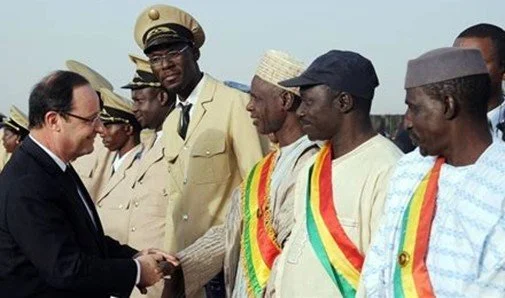
French president François Hollande greets officers and elected Malian officials in 2012 after French troops & helicopters saved Bamako from jihadist takeover. There are no longer any French soldiers in Mali in 2025.
West Africans have been victims for 500 years. The first Europeans were the Portuguese, at the end of the 15th century, and gold was the main European motivation for conquest. The Spanish, Dutch, British and French and came to rival Portuguese greed for Gold, but in the end Europe’s wealth came from Ivory, Spices and Slaves. As Spanish interest moved to Latin America, and the Dutch took the East Indies, West Africa was largely divided between Portugal, Britain and France. With the sailors, came the missionaries.
Slaves were needed for sugar, cotton and tobacco plantations in the Americas. The island of Gorée, off Dakar, changed hands multiple times as the slave trade expanded. Each European power controlled a river estuary, establishing trading posts and dominance over local African chiefs. Moving southwards, the Senegal river was French; Gambia was British; Ziguinchor was Portuguese, then French; Bissau was kept by Portuguese; Guinea was French; Sierra Leone and Ghana became British; Togo went from Germany to becoming a French protectorate; Benin next door was French; but Lagos and Port Harcourt were occupied by the Brits….. Even the United States got in on the act eventually, when Liberia was established in the 1820s by Africans returning from America to create their own Free State.
With trade came religion. The first Africans to reach the British colony of Virginia (named for Elizabeth I, the Virgin Queen) came from Angola. Captured on the high seas, ship logs proved their forcible conversion to Catholicism on a beach, before they boarded a slave ship bound for Brazil. One was African woman was baptised Angela. Her arrival in 1619 is recorded in the Jamestown museum (together with 19 Angolan men).
The rivalry between religions was colonial. Islam reached West Africa during the 800s, crossing the Sahara Desert from the Mediterranean coast which had been conquered by Arab armies. The arrival of Islam with the merchant camel caravans was peaceful: it seems that West Africans admired the discipline of Arab merchants who established themselves in the cities of the medieval Tekrour, Ghana, Susu and Mali kingdoms. They listened with interest to the preachers who arrived with the camels. When the Mali Empire was founded in 1235 by Sunjata Keita, the original Lion King, Islam replaced the fetishism of Sumanguru Kanté, the defeated king of Susu.
There was no medieval Arab attempt at colonization. Yet in 1980 when I first began to work in Mali, three rival imported religions were actively seeking converts: 92% of Malians professed to follow Islam, which had an 800-year advantage over the European imperial imports of Catholicism and Protestantism. Most Malians thought Catholicism was French, while Protestantism was American or Norwegian (since both funded development projects with church elements attached). Most Malians also followed elements of their ancestral religion, imploring their ancestors to intercede with The Almighty because humans are too feeble to address The Creator directly. Therein lies the religious difference: Islam and Christianity (in their multiple forms) allow the Believer to enter into direct conversation with God, and this weakens the African patriarchal system.
West African Islam was Sufi-inspired, but I also discovered some Wahhabists in 1980. Merchants trading with Arabia could obtain interest-free credits from Arab banks. A few preachers were promoting Salafist ideas in the Sahel and their offerings appealed especially to Africans who had performed the Haj pilgrimage to Mecca. I arrived precisely at the moment when Arab and Saudi ambitions began to change into a Wahhabist imperial project.
The year 1979 transformed the politics of ISLAM
1979 was a year of immense significance for Islamic politics. In February 1979 Shah Mohammed Reza Pahlavi fled Iran, ceding power to the Ayatullah Ruhullah Khomeiny who established a theocratic Islamic (Shia) State. This was the first time since the fall of the Ottoman Empire half a century earlier, that Islam had so clearly entered the political arena. In December 1979, the whole Islamic world was electrified by the invasion of Muslim Afghanistan by the atheist Soviet troops of Leonid Brezhnev: a jihad was launched to free Afghanistan.
But the 1979 event that most concerned West Africa, was the November 20th coup d’état in Mecca that almost toppled the unpopular Saud dynasty. Led by a former soldier and Islamic militant called Juhayman, from the rival Otaybi tribe, who despised the corruption of the al-Saud regime, rebels took possession of the Holy Mosque of Mecca and held out for two weeks until the French president sent in gendarmes with poisoned gas (a form of paralyzing tear gas) to help the Saudi military clear the mosque, killing or arresting hundreds of rebels. 70 were executed in public across Saudi Arabia. This event shook the Saudi king Khalid bin Abdulaziz. To reinforce his position, the king bought off the Ulema, his powerful religious critics, using the vast new incomes he had received from the OPEC oil price increases of 1973. He reinforced Islamic law and the Saudi religious police, while funding large numbers of preachers to take the Wahhabist doctrine across the world …. to Pakistan and Afghanistan (where Osama Bin Laden was one of the main Saudi funding operators) …. and especially across Africa.
The combination of Iran and Afghanistan gave fervor and military passion to the Wahhabist missionary endeavor; and oil wells provided the money. If we look at Africa today, we can see how radical Islam - with weapons – has transformed the political colour of Somalia (where the al-Shabab movement has also fought in Kenya and Ethiopia), of Nigeria, Chad and Cameroon (the Boko-Haram movement has taken control of some areas and carried out large-scale kidnappings, creating a major refugee problem), and the Sahara Desert where Niger, Mali, Burkina Faso and Mauritania are threatened with State collapse. There is an “arc of terror” from the coast of Guinea and Senegal across the Sahara to Egypt, Sudan and Somalia.
Terror comes from ideology backed with weapons and ammunition, many of which come from the Arabian Peninsular and the Arabian Gulf. Whether it be the civil war in Sudan, or the jihadist terror strikes and fuel boycotts in Mali, there would not be this level of violence without funding from Saudis, from Qataris, and/or from the United Arab Emirates, all close allies of Europe and the USA. The 200-year hegemony of Christian colonial nations is coming to an end in West Africa, and it is being replaced by a Muslim imperial movement funded from Arabia.